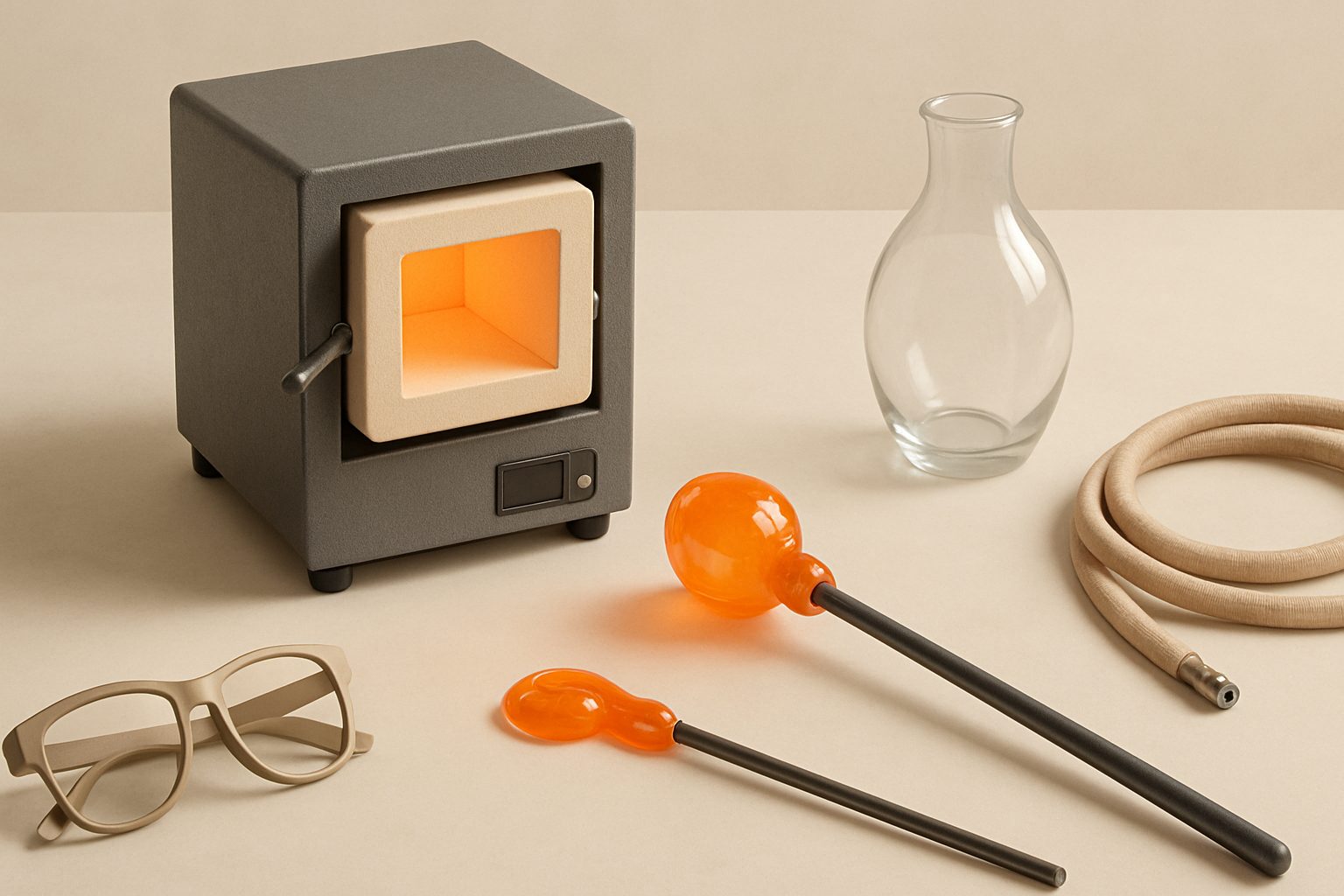
What Is a Glass Fusing Kiln and How Does It Work? (UK Beginner's Primer)
Glass fusing is one of the most forgiving ways to start making glass jewellery and decorative pieces at home. Unlike furnace work or torch firing, a fusing kiln does most of the hard work for you—you simply load glass, programme the temperature schedule, and let the kiln handle the heating and cooling. If you've been curious about glass fusing but aren't sure what you're actually buying or how the process works, this guide will give you the practical foundation you need.
What Is a Glass Fusing Kiln?
A glass fusing kiln is a specialised oven designed to heat glass slowly and evenly until the surfaces melt and fuse together, then cool it down gradually to avoid cracking. Unlike a pottery kiln, which reaches extreme temperatures and stays hot, a fusing kiln typically works between 500°C and 900°C depending on what you're trying to achieve. It's a contained, programmable heating chamber with elements on the sides or top, insulation to trap heat, and a control system that manages how fast the temperature rises and falls.
In the UK market, you'll find fusing kilns in two broad categories: traditional top-loaders and front-loading models. Top-loaders are popular for hobby use because they're compact and tend to be cheaper; front-loaders offer easier access to larger work and more even heat distribution, but take up more space and cost more upfront.
How the Fusing Process Actually Works
When you fuse glass, you're not melting it into liquid (that happens around 1100°C). Instead, you're heating it just enough that the surfaces soften and bond together. This typically happens at around 760–790°C, which glassmakers call the "glass transition" temperature—the point where glass becomes plastic enough to deform slightly but stays solid.
Here's the practical sequence:
Heating phase. You arrange your glass pieces on a prepared kiln shelf (often with a thin layer of kiln wash or frit to prevent sticking). The kiln warms up at a controlled rate—usually 3–5°C per minute. Too fast and you risk thermal shock; too slow and your project takes forever. Most people heat to somewhere between 750°C and 800°C for a standard full fuse.
Soak. Once you reach your target temperature, the kiln holds it steady for 15–30 minutes (depending on glass thickness). This is the "soak" phase, where heat has time to penetrate evenly through the entire piece. Thicker glass needs longer soak times.
Cooling phase. This is where your kiln's programming becomes crucial. You can't just switch the kiln off and let glass cool naturally—it will crack. Instead, the kiln cools in stages. The first stage might be a controlled drop from 790°C down to around 480°C (the annealing temperature) at roughly 2–3°C per minute. Then it drops faster through less critical temperature ranges, usually at 10°C per minute. Once below 300°C, cooling can be much faster.
Temperature Ranges and Fusing Schedules
The glass you use matters. Most UK beginners work with soft glass (often called soda-lime), which includes brands like Bullseye and Effetre. Soft glass fuses beautifully at relatively modest temperatures and is more forgiving than borosilicate (hard glass), which requires 880–920°C and slower cooling.
Here's a typical beginner schedule for soft glass:
- Heat to 790°C at 5°C per minute (full fuse)
- Soak at 790°C for 20 minutes
- Cool to 480°C at 3°C per minute
- Cool to room temperature at 10°C per minute or faster
If you're doing a "tack fuse" (just lightly bonding pieces together for a dimensional effect), you might stop at 700°C and only soak for 10 minutes. A full fuse gives you a stronger, flatter result.
Kiln Controllers: Manual vs Programmable
This is where you'll notice the biggest difference between budget and mid-range kilns. Basic kilns have a simple dial or switch that you turn up manually, and you monitor temperature with a separate pyrometer (temperature gauge). This works, but it's fiddly—you're standing over the kiln adjusting heat, trying to hit precise temperature changes.
Programmable controllers (called digital controllers or just "digital kilns") let you write a firing schedule into a keypad interface. You set the target temperature, the rate of temperature change, soak time, and cooling rates, then the kiln follows your programme automatically. You load glass, press start, and walk away. For hobbyists, this is the difference between frustration and relaxation. Most fusing kilns in the UK market under £2000 now come with basic digital control as standard.
Kiln Furniture and Loadable Space
What you put your glass on matters as much as the kiln itself. You'll need:
- Kiln shelves. Usually ceramic or composite. They sit inside the kiln on props or feet, and you place glass on top of them.
- Kiln wash. A protective coating (often alumina and silica) painted on shelves to stop glass fusing to them permanently.
- Stilts and trivets. Small ceramic supports that hold pieces up and away from the shelf surface for better heat circulation.
- Frit and separators. Powdered glass (frit) can act as a base layer; paper separators prevent pieces from sticking.
The "loadable space" is the actual interior area where you can fit work. A compact 30-litre kiln might have a shelf that's 30×30cm, which sounds bigger than it is once you account for shelves and heat circulation space needed around edges. Plan for useable area to be about 70% of what sounds available.
Next Steps
Now you understand the fundamentals: fusing kilns heat glass to around 760–800°C, soak briefly to let heat penetrate, then cool in stages to prevent cracking. A programmable controller removes the guesswork. The right kiln size and furniture complete the picture.
If you're ready to pick one, beginner and budget buying guides will walk you through actual kiln models, space considerations, and what features genuinely matter for your first year of work.
More options
- Paragon Kilns (Glass & Jewellery Range) (Amazon UK)
- Skutt Glass Kilns (Amazon UK)
- Digital Kiln Controllers & Pyrometers (Amazon UK)
- Glass Fusing Supplies & Kiln Furniture (Amazon UK)
- Lampworking & Glassblowing Tools (Amazon UK)