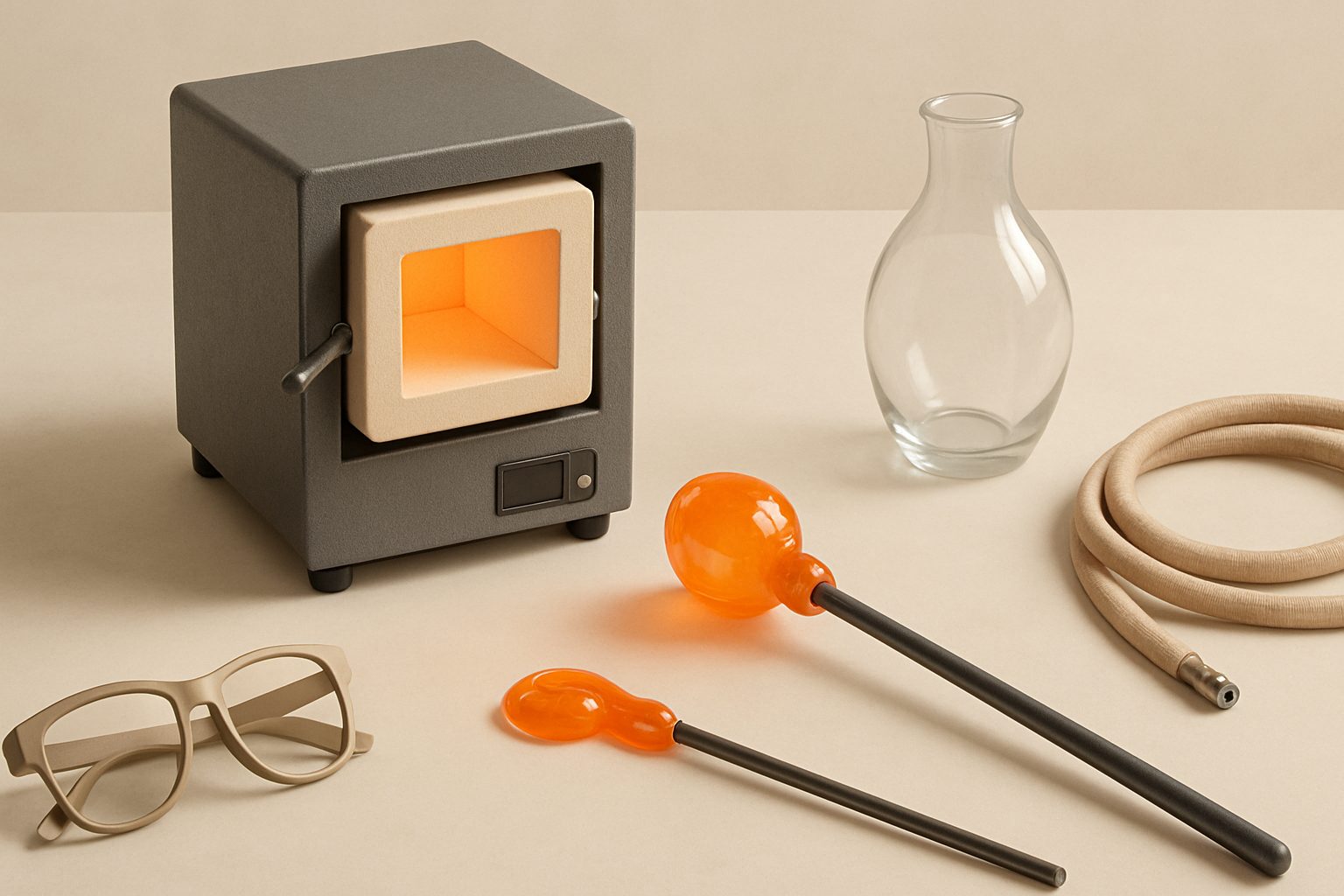
Best Lampworking Kilns for Home Studios in the UK — 2025 Guide
If you're lampworking at home, the kiln matters more than most beginners realise. A proper annealing kiln isn't just a nice-to-have—it's essential for keeping your borosilicate beads from shattering weeks after you've made them. The thermal stress inside the glass during cooling will crack it unless you anneal slowly and accurately, and a cheap or unreliable kiln is exactly how you end up with disappointing failure rates.
The challenge in the UK is that choice is more limited than in the US, stock is intermittent, and freight costs are genuinely steep. But there are solid options available, and understanding what to prioritise will save you both money and frustration down the line.
What makes a good lampworking kiln
An annealing kiln for lampwork has different requirements than a pottery kiln. Lampwork beads are typically small and don't need to reach the extreme temperatures that ceramics do, but they do need precise, slow temperature control. The kiln needs to hold a stable soak temperature (usually 480–510°C for borosilicate) for hours, then cool at a controlled rate—ideally no faster than 50°C per hour during the critical range around the transition temperature.
The best kilns for this job are tabletop models with digital controllers, thin firebrick, and efficient insulation. They heat quickly, maintain temperature reliably, and let you programme a cooling schedule so you can walk away without babysitting the thing.
Digital control is non-negotiable
If a kiln doesn't have digital temperature control, skip it. Manual pyrometer models require constant adjustment and guesswork, and you'll waste materials learning what "medium dial setting" actually gives you. Digital controllers let you programme a precise firing schedule: soak at 500°C for two hours, then ramp down at 50°C per hour until room temperature. That's the difference between consistent results and Russian roulette.
Look for kilns with PID controllers (proportional-integral-derivative), which adjust heating elements dynamically to hold temperature within 1–2°C. They're more stable than basic on/off thermostats, especially during the slow-cooling phase that matters most for annealing.
Hot Head compatibility matters
A significant number of UK lampworkers use Hot Head torch setups, and compatibility isn't automatic. Some annealing kilns—particularly older models or imports from outside the EU—may have voltage or physical design issues. If you're planning to use a Hot Head as your torch, check explicitly that any kiln you're considering will work with your torch's foot pedal and heating cycle. It's also worth asking the seller if they've sold to other UK Hot Head users.
This is less critical with Carlson, Bethlehem, or Nortel torch setups, but it's still worth confirming.
Size and heating speed
Kiln capacity for lampwork is typically 3–6 litres, which sounds small but is actually plenty for a home studio. You're not firing industrial quantities. A 3–4 litre kiln with 3–4 kW heating will reach 500°C in around 30–40 minutes and cost less to run than a larger model.
If you're a prolific maker or planning to teach, a 6-litre kiln makes sense. But for most home studios, a smaller footprint also means less bench space, faster warm-up, and lower energy costs—a genuine saving over time given how often you'll be firing.
Budget and value
Entry-level digital kilns in the UK market start around £900–1200. Mid-range models (4–5 litre, reliable brand, good warranty) sit at £1400–1800. Premium models with advanced controllers run £2000+.
Don't assume price tracks quality. A kiln from a maker with a strong UK support network and decent spares availability is worth more than a slightly cheaper import with a 12-month warranty and no distributor. Breakdowns are frustrating and costly when replacement parts take weeks to arrive from overseas.
Ceramabond and imported Chinese models can be fine, but check the warranty explicitly. Some UK distributors offer 2–3 year warranties on controllers and elements; others offer a single year with no local support. That difference compounds when something fails.
Ventilation and studio setup
A 4 kW kiln running at full heat will warm a small studio noticeably. You don't need industrial ventilation—lampwork annealing doesn't produce harmful fumes—but you do need airflow so the kiln doesn't overheat your workspace or create a fire risk.
Make sure your bench is sturdy and non-flammable, with at least 60 cm of clear space on all sides. Check your electrical setup: a 4–5 kW kiln needs a dedicated circuit on a modern consumer unit. Don't run it on an extension lead or shared circuit, regardless of what a seller tells you.
What to ask before buying
Before committing, ask the seller:
- What's the actual cool-down time from 500°C to 50°C?
- Does the controller come with pre-programmed cycles or do you have to build them yourself?
- How easily can you replace elements or the controller?
- Have they sold into the UK lampwork community before?
- What's the postage cost and how will it be packaged?
Kiln freight is expensive—expect £100–200 to the UK—so factor that into your decision.
Bottom line
For a home lampwork studio in the UK, a compact digital kiln from a distributor with local support is the sensible choice. Expect to spend £1500–1700 on something genuinely reliable, then keep it well-maintained and you'll use it for years. Cutting corners on the kiln is where most people find out that annealing actually matters.
More options
- Paragon Kilns (Glass & Jewellery Range) (Amazon UK)
- Skutt Glass Kilns (Amazon UK)
- Digital Kiln Controllers & Pyrometers (Amazon UK)
- Glass Fusing Supplies & Kiln Furniture (Amazon UK)
- Lampworking & Glassblowing Tools (Amazon UK)