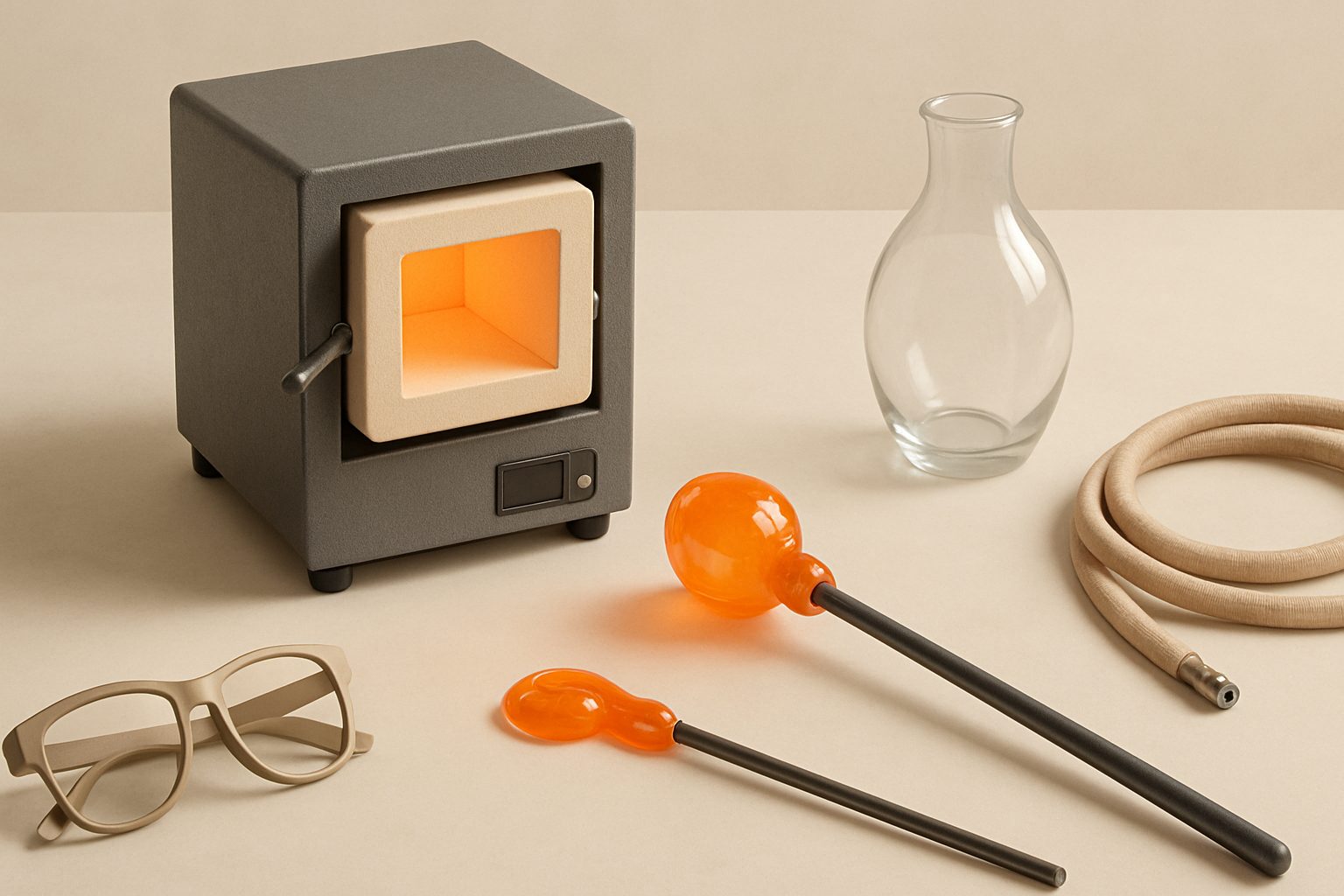
Best Kilns for Borosilicate Glasswork in the UK — Lampworkers' Guide
Borosilicate glass is unforgiving. It anneals at around 560°C and requires a kiln that can hold that temperature steady for hours without fluctuation. Pick the wrong kiln, and you'll spend more time fixing thermal shock cracks than actually making beads or vessels. If you're serious about borosilicate lampworking, your kiln choice matters as much as your torch.
Why Borosilicate Demands a Different Kiln
Borosilicate glass (typically soda-lime-boron or lead-boron compositions) has a much narrower annealing range than soft glass. Soda-lime glass forgives temperature variations of 20°C or more; borosilicate needs precision. Cool it too fast, and internal stress builds. Overshoot the annealing temperature and you'll soften the glass itself.
This is why a basic kiln marketed for "any glass" often fails. Cheap kilns with poor temperature distribution create hot spots. Kilns with undersized controllers drift by 5–10°C per hour. Borosilicate work exposes every weakness in kiln design.
You also need predictable ramp-down rates. Many kilns cool too fast at the critical 560–400°C window. The best borosilicate kilns either have programmable cooling cycles or enough thermal mass to cool naturally at the right speed.
Temperature Control and Stability
Look for a kiln with:
- PID controller (not just on/off relays) — essential for holding within ±5°C of target
- Calibrated thermocouple that reads accurately; ask the supplier about certification
- Adequate insulation — 3 inches of firebrick minimum, ideally more
- Chamber size that matches your output — oversized kilns take longer to cool and waste energy; undersized ones can't hold stable temperature with a full load
A useful spec you'll see: ramp rate control. Some kilns let you programme a 100°C/hour climb, then a slower 30°C/hour descent from 600°C down to 300°C. This is the difference between sound work and a drawer full of cracked beads.
Paragon SC Series
Paragon's SC (small chamber) range, particularly the SC-18 and SC-27, is the most popular choice among UK boro lampworkers. Here's why:
The SC-18 holds 18 cubic inches and costs around £800–1000. It's compact enough for a garage or shared studio space. The PID controller is factory-calibrated, and the kiln has enough insulation to maintain temperature within ±3°C once stabilised. Ramp rates are programmable.
The SC-27 offers 27 cubic inches (roughly 40% more capacity) for around £1200–1500. Same temperature control, same build quality.
Honest trade-offs: Paragon kilns are US-made, so UK importers add margin — you'll pay more than European alternatives in some cases. Spare parts (elements, thermocouples, controllers) ship from the US, which takes time and costs money. The chamber is small, so large sculptural pieces need breaking into smaller anneal passes. Resale value in the UK is good, though, and support forums are active.
Both models have a learning curve with the programming interface, though it's nothing complex. Many UK users stick to one or two saved programmes and never touch the settings again.
Skutt KM Series
Skutt's KM series is less common in UK boro circles than Paragon, but it's solid. The KM22 and KM24 are roughly equivalent to the SC-18 and SC-27 respectively.
Skutt designs these kilns specifically for glass artists. Temperature stability is good (±2–3°C), and the controller is intuitive. Slightly easier programming than Paragon for beginners. Cost is comparable: £900–1200 for the KM22.
Drawbacks: Skutt is even more firmly US-focused in terms of support. UK distributor availability is patchier. Parts take longer to arrive. That said, the kilns are reliable; failure rates are low.
If you find a UK distributor with stock and support, this becomes the easier buy.
Other Considerations
Ventilation. Borosilicate work produces fumes (copper compounds, cobalt, whatever's in your colour rods). Ensure your kiln sits in a space with extraction or good ambient air flow. This won't change which kiln you pick, but it's non-negotiable for health.
Power supply. Both Paragon and Skutt models run on 240V single-phase in the UK. Check your circuit capacity — a larger kiln can draw 30–40A on start-up. Don't wire it through an extension lead.
Footprint. An SC-18 is roughly the size of a small microwave. An SC-27 is noticeably bulkier. Measure your studio space before ordering.
Annealing Programme Basics
Once you've bought the kiln, you need the right programme. A basic boro annealing schedule:
- Heat to 560°C at 100°C/hour (no faster — thermal shock)
- Soak at 560°C for 30 minutes per 6 mm thickness (longer than soft glass)
- Cool to 450°C at 30°C/hour (the critical window)
- Cool from 450°C to room temperature at full speed (about 100°C/hour)
Different rod batches and bead sizes need tweaking, but this is the starting point. Keep notes; you'll refine it.
Related Reading
For a wider comparison of kilns suitable for general lampworking (including soft glass), see our guide to the best lampworking kilns in the UK. That article covers budget options and compact models not suitable for borosilicate but worth knowing about.
Final Thought
Borosilicate is harder to work than soft glass, but it's worth the discipline. A proper kiln is the single biggest factor in consistent results. Paragon SC series is the safer bet for UK buyers right now — longer track record, more second-hand stock, clearer support. Skutt KM models are a close second if you find a reliable local distributor. Either way, don't compromise on temperature control.
More options
- Paragon Kilns (Glass & Jewellery Range) (Amazon UK)
- Skutt Glass Kilns (Amazon UK)
- Digital Kiln Controllers & Pyrometers (Amazon UK)
- Glass Fusing Supplies & Kiln Furniture (Amazon UK)
- Lampworking & Glassblowing Tools (Amazon UK)